VisionAR

VisionAR: AI Tool for 3D Models – Fast & Precise

VisionAR: AI tool transforming 2D images/sketches into pro-grade 3D models fast. Revolutionize design with VisionAR—precision, speed, simplicity.

🟢

VisionAR - Introduction

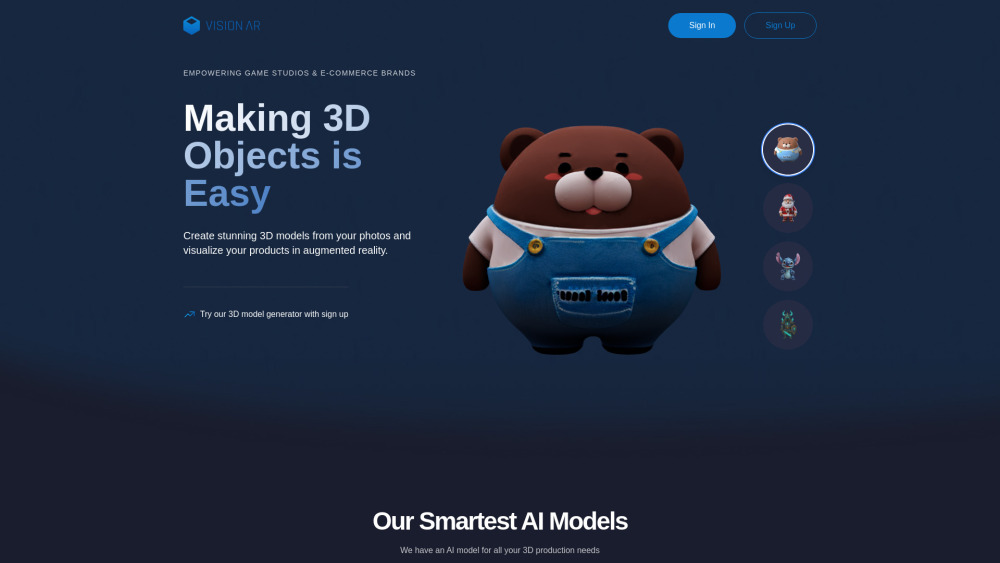
VisionAR Website screenshot

What is VisionAR?

VisionAR is an advanced AI-driven platform that turns simple 2D visuals—like photos or hand-drawn sketches—into high-quality, fully textured 3D models in moments. Leveraging its proprietary V-Pix and V-Poly AI engines, it generates professional 3D assets from just one to four reference images within two minutes. For concept artists or designers without source photography, the intuitive 'Scribble mode' transforms rough drawings into viable model inputs. Built for efficiency, VisionAR supports industries such as gaming and digital commerce by enabling rapid prototyping, AR integration, and seamless export of models in widely compatible formats like GLB. With next-gen tools like VNeuro for ultra-detailed poly meshes and VFuse for real-time mobile scanning on the horizon, VisionAR is shaping the future of 3D content creation.

How to use VisionAR?

Using VisionAR is fast and straightforward. Begin by uploading either a single image or up to four angled views of your subject. The platform's intelligent V-Pix/V-Poly AI analyzes the input and constructs a detailed 3D model in under 120 seconds. If you don’t have photographs, switch to 'Scribble mode' and upload a basic sketch—the system interprets your lines to generate a realistic 3D representation. Once processing is complete, review your model in the viewer, apply adjustments if needed, and download it in GLB format for use in design software, game engines, or e-commerce platforms. No technical expertise required—just upload, generate, and go.

🟢

VisionAR - Key Features

Key Features From VisionAR

AI-Powered 2D-to-3D Conversion (V-Pix/V-Poly AI)

Scribble Mode: Turn Sketches Into 3D-Ready References

Instant Download of Models in GLB Format

Augmented Reality Product Visualization Tools

API Access Available for Enterprise & Developer Plans

Upcoming VNeuro Model: High-Polygon Assets from Up to 150 Images

Coming Soon – VFuse: One-Tap Mobile Scanning for Instant 3D Capture

🟢

VisionAR - Frequently Asked Questions

FAQ from VisionAR

What is VisionAR?

How do I create a 3D model with VisionAR?

What 3D model formats can I download?

Do you offer custom solutions for businesses?

  • VisionAR Support Email & Customer Service Contact

    For support inquiries, reach out via email at [email protected]. For additional assistance, visit our contact page to connect with our team directly.

  • VisionAR Company

    Official company name: VisionAR

FAQ from VisionAR

What is VisionAR?

VisionAR is a cutting-edge AI platform that converts 2D inputs—such as photos or sketches—into precise, immersive 3D models in seconds. Powered by V-Pix and V-Poly AI, it enables creators to build pro-level assets using minimal visual data. Whether you're working with full photo sets or rough doodles, VisionAR streamlines 3D modeling for industries ranging from gaming to online retail. It also supports augmented reality previews and offers upcoming features like VNeuro for hyper-realistic detail and VFuse for instant mobile scanning.

How do I create a 3D model with VisionAR?

To generate a 3D model, simply upload 1–4 images of your object, and let VisionAR’s AI reconstruct it in three dimensions within two minutes. If no photos are available, use Scribble mode to draw a quick concept—the AI will interpret your sketch and produce a corresponding 3D model ready for refinement or export.

What 3D model formats can I download?

All generated models can be downloaded in GLB format—a compact, universally supported standard ideal for web, AR applications, and 3D editing tools like Blender or Unity.

Do you offer custom solutions for businesses?

Yes. VisionAR’s Enterprise plan includes tailored workflows, unlimited model generation, dedicated customer support, priority processing, and API access for seamless integration into large-scale production pipelines.