Vanna: Your AI Business Intelligence Assistant

Vanna: AI Tool for SQL Generation & BI Queries

Vanna: Your AI Business Intelligence Assistant: This ai tool generates SQL for Snowflake, BigQuery, Athena, Postgres—empowering data teams with instant query creation.

🟢

Vanna: Your AI Business Intelligence Assistant - Introduction

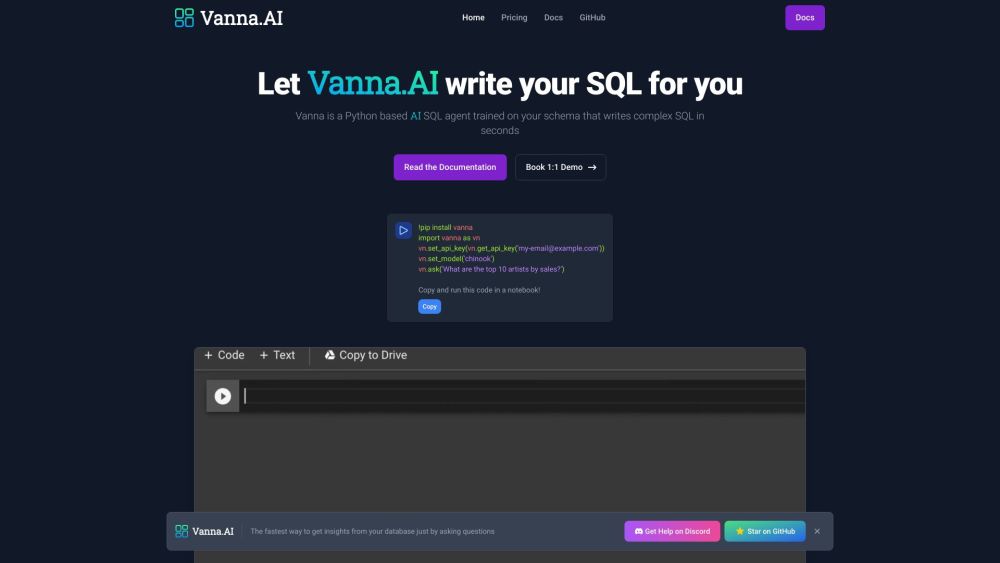
Vanna: Your AI Business Intelligence Assistant Website screenshot

What is Vanna: Your AI Business Intelligence Assistant?

Vanna is an advanced AI-driven tool designed to simplify database interactions by automatically generating accurate SQL queries. Built as a lightweight Python framework, it enables data analysts, engineers, and business teams to translate natural language questions into executable SQL for platforms like Snowflake, BigQuery, Amazon Athena, and PostgreSQL—making data access faster and more intuitive.

How to use Vanna: Your AI Business Intelligence Assistant?

Getting started with Vanna is simple: install the 'vanna' package via pip, configure your preferred LLM API key, and connect it to your database schema. Once trained on your data structure, you can use the 'ask' method to pose questions in plain English. Vanna will instantly return syntactically correct SQL tailored to your environment, streamlining query development and reducing manual effort.

🟢

Vanna: Your AI Business Intelligence Assistant - Key Features

Key Features From Vanna: Your AI Business Intelligence Assistant

Natural Language to SQL Conversion

Turn everyday business questions into precise SQL statements without writing a single line of code.

Multi-Database Compatibility

Seamlessly works with major data warehouses including Snowflake, Google BigQuery, AWS Athena, and PostgreSQL, ensuring broad enterprise applicability.

Custom Model Training

Train Vanna on your specific database schema and terminology to boost accuracy and relevance for your organization's unique use cases.

Continuous Learning Mechanism

The system improves over time by learning from corrections and successful queries, enhancing performance with ongoing usage.

Data Privacy & Security

Your schema and training data remain under your control—no external sharing unless explicitly configured by you.

Flexible Integration Options

Easily embed Vanna into Jupyter notebooks, internal dashboards, Slack bots, or customer-facing web applications for real-time SQL generation.

🟢

Vanna: Your AI Business Intelligence Assistant - Frequently Asked Questions

FAQ from Vanna: Your AI Business Intelligence Assistant

What is Vanna: Your AI Business Intelligence Assistant?

Vanna is an open-source, AI-powered assistant that converts natural language into accurate SQL queries. It's built to accelerate data analysis across modern cloud data platforms using customizable machine learning models.

How to use Vanna: Your AI Business Intelligence Assistant?

Install the Vanna Python library, authenticate with your chosen LLM provider, connect your database schema, and begin asking questions. The 'ask()' function returns ready-to-run SQL based on your context and history.

What databases does Vanna support?

Vanna natively supports Snowflake, BigQuery, Athena, and Postgres, but its modular design allows integration with virtually any SQL-based database through proper configuration.

How does Vanna ensure high accuracy in SQL generation?

Accuracy is driven by targeted training on your schema, sample queries, and feedback loops. The more domain-specific training data provided, the better Vanna understands your data landscape.

Can I use Vanna with my own database and schema?

Absolutely. Vanna is designed to be trained on your private database schema and query patterns, ensuring personalized and secure SQL generation without exposing sensitive structures.

Does Vanna continuously improve over time?

Yes. As you interact with Vanna and validate outputs, it retains knowledge from past successes and adjustments, enabling smarter responses with continued use.

What are some practical applications of Vanna?

Use Vanna to automate report generation, empower non-technical users to explore data, reduce SQL drafting time for engineers, build intelligent chatbots for analytics, or integrate SQL capabilities into SaaS products.