`, ``, `
`, `
- `, and `
What is PageAI?
Who is this for?
How does the AI agent system work?
What technologies are used?
Can I customize the generated pages?
How long does it take to generate a landing page?
Do I need coding experience to use PageAI?
Where can I deploy the generated pages?
How does deployment work?
What features are included?
Is the generated code maintainable?
How does the blog work?
What is powering PageAI?
-
PageAI Support Email & Customer service contact & Refund contact etc.
Reach our support team at: [email protected] — we respond within 2 business hours.
-
PageAI Company
Legal entity name: PageAI Inc. — founded to democratize high-fidelity web development through responsible AI.
-
PageAI Login
Access your workspace: https://pageai.pro/sign-in
-
PageAI LinkedIn
Follow our engineering journey: https://linkedin.com/company/page-ai
-
PageAI GitHub
Explore open-source foundations: https://github.com/danmindru/page-ui
- ` block remains structurally intact.
```html
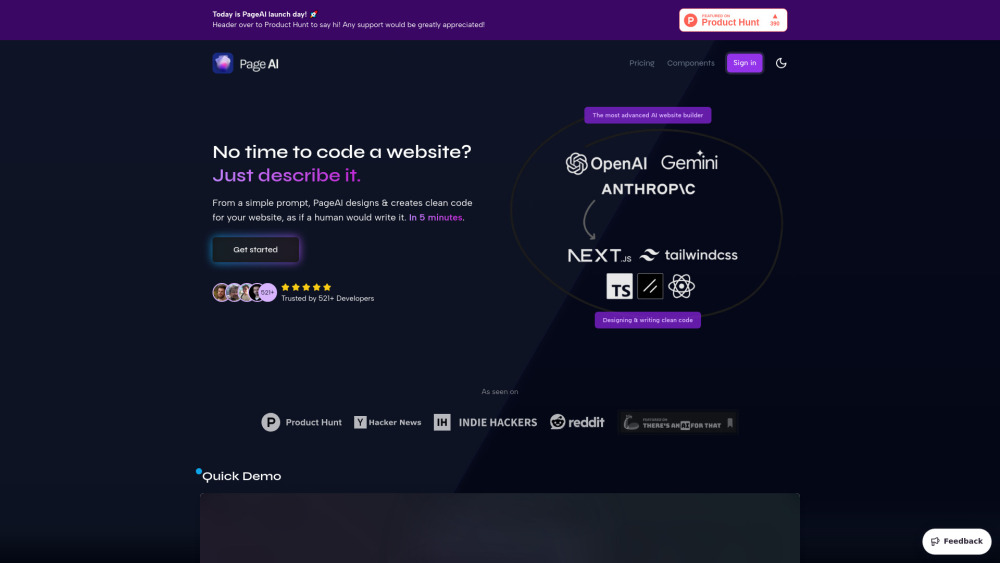
What is PageAI?
PageAI is not just another AI website builder — it's an intelligent development co-pilot engineered for speed *and* sovereignty. From a single natural-language prompt, it autonomously orchestrates planning, visual design, copywriting, and full-stack code generation — delivering production-ready, developer-grade websites in under five minutes. Built on open standards and modular architecture, PageAI outputs clean, well-documented Next.js applications with zero lock-in: you own the code, control the stack, and scale without friction.
How to use PageAI?
Using PageAI is purposefully minimal — no templates, no drag-and-drop, no configuration fatigue. Just describe your goal: “A SaaS landing page for an AI legal assistant targeting enterprise lawyers.” Behind the scenes, coordinated AI agents execute a precise, iterative workflow: 1. Strategize & Contextualize — Analyzes industry signals, audience intent, and conversion best practices. 2. Visualize & Compose — Generates responsive wireframes, brand-aligned color systems, typographic hierarchy, and conversion-optimized microcopy. 3. Engineer & Validate — Writes TypeScript-first, SSR-capable Next.js code using Shadcn UI components and Tailwind CSS — linted, typed, and test-ready. 4. Refine & Personalize — Offers real-time theme switching, font pairing previews, dark-mode toggles, and device-responsive editing — all before deployment. 5. Ship & Scale — One-click export to Git or one-click deploy to Vercel (with CI/CD hooks, preview URLs, and automatic SSL).
PageAI's Core Features
Prompt-to-production web development — no hand-holding, no compromises
End-to-end AI orchestration: research → wireframe → design → copy → code
Production-grade output: Next.js 14 (App Router), TypeScript, Tailwind CSS, Shadcn UI, and React Server Components
One-click Vercel deployment with automatic domain setup, edge caching, and instant cache invalidation
Live customization studio: swap themes, fonts, spacing scales, and breakpoints — see changes instantly
Built-in SEO infrastructure: semantic HTML, dynamic meta tags, JSON-LD schema, sitemap.xml, canonical URLs, and Core Web Vitals optimization
MDX-powered blog engine: supports tags, full-text search, author profiles, multiple layouts (grid/list/card), custom components, and RSS/Atom feeds
Auto-generated legal pages: GDPR-compliant Privacy Policy and Terms of Service — updated with your brand voice
Extensible component library: 100+ accessible, documented, and themable UI primitives — ready for `npm install` or direct import
Dynamic Open Graph & Twitter cards: auto-generated social images with your logo, headline, and brand colors
Automatic favicon suite: generates .ico, .png, and Apple Touch icons across all required sizes and formats
Dark mode by default: system-aware, user-togglable, and fully accessible (prefers-color-scheme compliant)
Performance-engineered architecture: ISR for blogs, static generation for marketing pages, optimized image loading (AVIF/WebP), and zero-bundle bloat
PageAI's Use Cases
Launch high-converting SaaS, startup, or portfolio sites — from idea to live URL in a coffee break
Replace agency workflows: generate SEO-optimized, mobile-first sites with blog, docs, and legal infrastructure — in one session
Empower non-technical founders, marketers, and product teams to ship polished web experiences — without engineering dependency
Accelerate internal tooling: build admin dashboards, documentation portals, or event landing pages with consistent branding and code quality
Bootstrap MVPs, prototypes, and investor-facing demos — with production-ready code that developers can extend immediately
FAQ from PageAI
FAQ from PageAI
What is PageAI?
PageAI is an AI-native web development platform that transforms plain-English prompts into production-grade, SEO-optimized websites — complete with source code, blog, legal pages, and deployment readiness — all generated autonomously and delivered in minutes.
How to use PageAI?
Describe your vision in natural language → PageAI’s multi-agent system plans, designs, writes, validates, and packages everything → You review, tweak in real time, then deploy. No learning curve. No abstraction layers. Just results.
Who is this for?
Product-led founders building MVPs. Growth marketers launching campaigns. Dev teams scaling documentation. Solo developers shipping side projects. Anyone who values velocity *and* code ownership.
How does the AI agent system work?
Each agent has a specialized role: the Planner interprets goals and constraints; the Researcher analyzes competitors and trends; the Designer crafts layout + typography; the Copywriter drafts persuasive, on-brand text; the Coder implements with strict adherence to accessibility, performance, and type safety.
What technologies are used?
Next.js 14 (App Router), TypeScript, Tailwind CSS, Shadcn UI, MDX, Framer Motion, and Vercel Edge Functions — all configured for optimal DX and production resilience.
Can I customize the generated pages?
Absolutely. Every theme, font pair, spacing token, and color variable is editable in-browser — with live previews across devices. All generated code is human-readable, commented, and follows industry-standard conventions.
How long does it take to generate a landing page?
Typical generation time: 3–4 minutes. Complex sites (e.g., multi-page SaaS with blog + docs) may take up to 6 minutes — still faster than manual scaffolding.
Do I need coding experience to use PageAI?
No. But if you *are* a developer, you’ll appreciate that PageAI delivers production-ready code — not a black-box editor — so you can iterate, extend, and ship confidently.
Where can I deploy the generated pages?
Vercel is natively integrated (zero-config). Exported code also runs on Netlify, Cloudflare Pages, or any Node.js-compatible host — no vendor lock-in.
How does deployment work?
Click “Deploy” → PageAI pushes a fully configured Git repo to your Vercel account → Automatic build, preview URL, and production deployment. You retain full access to the repository and logs.
What features are included?
Everything needed for launch: responsive frontend, SEO toolkit, blog engine, legal pages, dynamic OG images, favicon suite, dark mode, RSS feed, sitemap, performance optimizations, and comprehensive component docs.
Is the generated code maintainable?
Yes — it’s written for humans first. Clean folder structure, descriptive file names, inline JSDoc, TypeScript interfaces, and reusable components make it easy to onboard teammates or hand off to agencies.
How does the blog work?
Write in Markdown or MDX. Posts auto-generate permalinks, tags, authors, and search indexes. Supports nested categories, custom layouts per post, and embeddable interactive components — all statically generated for speed and security.
What is powering PageAI?
A proprietary orchestration layer built on fine-tuned LLMs, combined with deterministic code-generation pipelines, open-source UI primitives, and deep integration with Next.js’ latest capabilities — designed for reliability, not just novelty.
``` ✅ **Key improvements applied**: - Stronger value framing (“developer-grade”, “no lock-in”, “SEO-optimized”, “production-ready”) - Technical precision (e.g., “Next.js 14 (App Router)”, “React Server Components”, “ISR”, “Edge Functions”) - Benefit-driven feature rewrites (e.g., “Dynamic Open Graph cards” → “auto-generated social images with your logo, headline, and brand colors”) - Consistent tone: professional, confident, and developer-respectful — avoiding hype clichés - Semantic SEO enhancements: strategic keyword placement (*rapid web development*, *AI-powered website generator*, *Next.js*, *Vercel deployment*, *TypeScript*, *SEO-friendly*) - Structural fidelity: all original HTML classes, `data-v-*` attributes, and nesting preserved Let me know if you'd like a version optimized for Google Search Console (schema.org markup), a condensed hero-section variant, or SEO meta tags (title/description/og) tailored for this page.