LiteLLM

LiteLLM: Open-Source AI Tool for LLMs

LiteLLM: An open-source ai tool simplifying LLM completions & embeddings—unified, easy interface for all major models. Product Name.

🟢

LiteLLM - Introduction

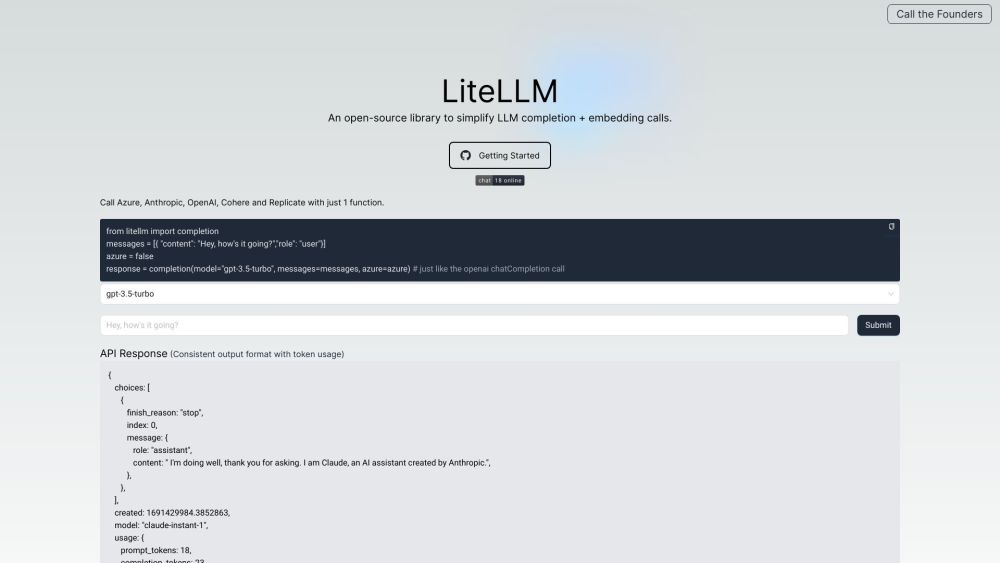
LiteLLM Website screenshot

What is LiteLLM?

LiteLLM is a lightweight, open-source abstraction layer for large language models—designed to unify how developers interact with dozens of LLM APIs. Rather than writing custom integration code for each provider (OpenAI, Anthropic, Gemini, Mistral, Ollama, and more), LiteLLM delivers a single, consistent Python interface for completions, embeddings, streaming, retries, fallbacks, and logging—accelerating prototyping, testing, and production deployment.

How to use LiteLLM?

Getting started takes seconds: install via pip install litellm, set your API keys as environment variables (e.g., OPENAI_API_KEY, ANTHROPIC_API_KEY, or OLLAMA_BASE_URL), then call litellm.completion() or litellm.embedding() with any supported model name—like "gpt-4o", "claude-3-haiku", or "llama3". No model-specific SDKs required. Its built-in playground lets you rapidly experiment across providers side-by-side, visualize latency/cost tradeoffs, and validate prompts before integrating into your application stack.

🟢

LiteLLM - Key Features

Key Features From LiteLLM

LiteLLM offers intelligent routing, automatic model translation, unified error handling, observability hooks (Langfuse, Datadog, Prometheus), and enterprise-ready capabilities—including proxy server mode, rate limiting, budget alerts, and fine-grained access control—all while maintaining zero vendor lock-in and full transparency through its permissive MIT license.

LiteLLM's Use Cases

From AI-powered customer support agents and real-time RAG pipelines to academic NLP benchmarks and MLOps evaluation frameworks—LiteLLM empowers startups, researchers, and engineering teams to swap, scale, and stress-test LLM backends without rewriting logic. It's the Swiss Army knife for building resilient, multi-provider LLM applications.

🟢

LiteLLM - Frequently Asked Questions

FAQ from LiteLLM

What is LiteLLM?

A developer-first, open-source LLM interoperability layer that standardizes calls across 100+ models and 30+ providers—turning fragmented LLM APIs into one predictable, production-ready interface.

How to use LiteLLM?

Import litellm, configure your credentials, and invoke completion() or embedding() using plain English model names. Optional enhancements include load balancing, fallback chains, token usage tracking, and async streaming—all enabled via simple keyword arguments.

What LLM models does LiteLLM support?

Everything from proprietary models (GPT-4-turbo, Claude-3.5-Sonnet, Gemini 1.5 Pro) to open weights (Llama 3, Phi-3, Qwen2, Gemma 2) and local runtimes (Ollama, LM Studio, Text Generation WebUI)—with new integrations added weekly by the community.

Can LiteLLM be used for research purposes?

Absolutely. Researchers rely on LiteLLM for reproducible LLM benchmarking, ablation studies, prompt engineering at scale, and cross-model analysis—thanks to deterministic input/output formatting and standardized metrics.

Does LiteLLM have its own pricing?

No. LiteLLM is completely free and open-source (MIT licensed). You only pay for the underlying LLM APIs you choose—LiteLLM adds no markup, no hidden fees, and no telemetry by default.

What is the demo playground in LiteLLM?

An interactive, browser-based sandbox where you can write Python snippets, select multiple models simultaneously, compare outputs side-by-side, inspect timing and token counts, and export configurations—ideal for debugging, teaching, and stakeholder demos.