Kimi k2

Kimi k2: Open-Source AI Tool Outperforms GPT-4

Kimi k2: Open-source ai tool outperforms GPT-4 with 95% less cost—powerful, efficient, and built for the future. Product Name redefines AI.

🟢

Kimi k2 - Introduction

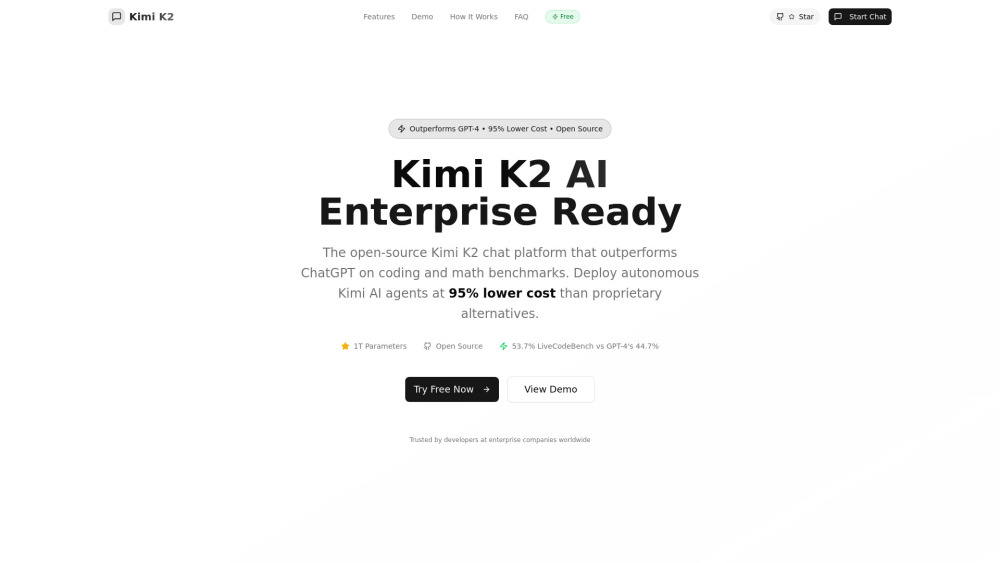
Kimi k2 Website screenshot

What is Kimi k2?

Kimi K2 is a next-generation, open-source AI platform engineered to redefine how businesses and developers interact with artificial intelligence. As a high-performance alternative to closed models like GPT-4, Kimi K2 delivers superior results in coding and mathematical reasoning while reducing operational costs by up to 95%. Built on a Mixture-of-Experts (MoE) architecture, it supports massive context handling of up to 128K tokens and enables autonomous AI agents capable of executing complex tasks independently. With an API-first approach and robust enterprise features—including SSO, audit logging, and self-hosting options—Kimi K2 is designed for scalability, security, and seamless integration into modern workflows.

How to use Kimi k2?

Getting started with Kimi K2 is fast and frictionless—users can begin interacting with the AI instantly through the web interface at no cost and without needing to sign up. For teams and enterprises, deployment is streamlined into three steps: Sign up for a free account, choose between cloud-hosted or self-hosted infrastructure, configure workspace settings such as access controls and integrations, then scale across your organization by inviting team members. Developers can deploy locally using a simple Docker command, enabling full control over environment, data privacy, and compliance requirements from day one.

🟢

Kimi k2 - Key Features

Key Features From Kimi k2

Open-source AI framework with full model transparency

Exceeds GPT-4 performance in code generation and math problem solving

True agentic behavior: autonomously plans, executes, and iterates on tasks

Up to 95% lower inference cost compared to proprietary LLMs

Supports self-hosting for enhanced data governance and regulatory compliance

Massive 128K token context window for long-form analysis and multi-document processing

Enterprise-grade architecture with MoE, API-first design, SSO, and audit trails

Natural, human-like conversational flow with deep contextual understanding

Advanced code capabilities: write, debug, optimize, and explain in multiple languages

Sophisticated reasoning engine for data analysis, logic puzzles, and STEM challenges

Ultra-low latency responses for real-time interaction and production use

🟢

Kimi k2 - Frequently Asked Questions

FAQ from Kimi k2

How does Kimi K2 compare to ChatGPT and Claude?

Kimi K2 outperforms both GPT-4 and Claude in key technical benchmarks—achieving 53.7% on LiveCodeBench versus GPT-4's 44.7%, and 97.4% on MATH-500 compared to 92.4%. It also offers dramatically lower pricing at $0.15–$2.50 per million tokens, representing up to 95% savings over OpenAI and Anthropic’s offerings.

What makes Kimi K2 'agentic' compared to other AI models?

Unlike traditional chatbots, Kimi K2 is architected for true agentic intelligence—meaning it can independently break down goals, write and run code, call tools, and complete multi-step workflows without constant user input, mimicking a skilled digital employee.

Can I self-host Kimi K2 for data privacy and compliance?

Yes—Kimi K2 is fully open-source with publicly available model weights, allowing secure deployment on private servers or internal cloud environments. This ensures full compliance with GDPR, HIPAA, and other regulatory frameworks.

What's included in the free tier, and are there usage limits?

The free tier grants immediate access to Kimi K2’s full feature set with no registration required. While specific rate limits aren’t disclosed, the platform allows generous exploration of its capabilities for individuals and small teams.

How do you ensure model performance and reliability?

Kimi K2 undergoes rigorous benchmarking and continuous optimization. It maintains a 99.9% uptime SLA and consistently ranks at the top of coding and math evaluations, ensuring dependable, high-quality outputs in production environments.

What kind of support and documentation is available?

Users gain access to comprehensive documentation, developer tutorials, code examples, and active community forums. Enterprise customers also receive dedicated technical support and onboarding assistance.