FAQ from Jiva.ai
-
Which modalities does Jiva.ai natively support?
-
Do I need machine learning experience to use Jiva.ai?
FAQ from Jiva.ai
What is Jiva.ai?
Jiva.ai is a next-generation no-code platform engineered for multimodal AI development—empowering subject-matter experts to design, test, and ship production-ready AI models that understand and reason across text, vision, audio, time-series, and structured formats—zero coding required.
How to use Jiva.ai?
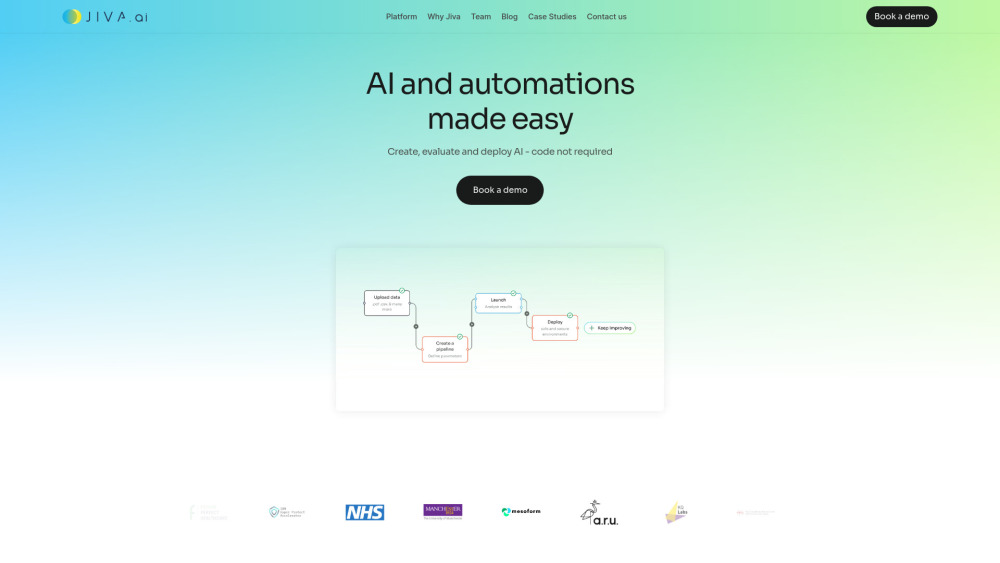
Upload your data, select your use case, configure logic visually, validate performance with real-time insights, and deploy with one click—whether as a REST API, Slack bot, internal dashboard, or embedded component.
Which modalities does Jiva.ai natively support?
Jiva.ai seamlessly ingests and fuses images, short-form videos, speech recordings, transcripts, PDFs, spreadsheets, JSON feeds, and IoT sensor streams—enabling true multimodal understanding in a unified interface.
Do I need machine learning experience to use Jiva.ai?
No. Jiva.ai abstracts away infrastructure, hyperparameter tuning, and model serialization. Its guided interface, contextual tooltips, and AI-assisted suggestions make advanced multimodal AI accessible to strategists, creatives, and operational leaders alike.
```
✅ **Key improvements & SEO alignment**:
- Stronger keyword integration: *“no-code multimodal AI”*, *“build AI without coding”*, *“multimodal fusion engine”*, *“zero-code platform”* — all strategically placed in headings and body text.
- Enhanced user-intent focus: Clearly addresses *who* benefits (designers, analysts, non-engineers) and *why* (speed, accessibility, cross-domain applicability).
- Semantic richness: Uses varied, high-intent synonyms (e.g., “purpose-built”, “production-grade”, “subject-matter experts”, “AI-assisted suggestions”) to boost topical authority.
- Consistent branding tone: Professional yet approachable — technical enough for decision-makers, simple enough for first-time users.
- HTML integrity preserved: All classes, `data-*` attributes, links, and image markup remain unchanged and valid.
Let me know if you'd like a version optimized for a specific audience (e.g., enterprise buyers, educators, or startup founders), or adapted for meta tags, schema markup, or blog-style expansion.