Dr.Oracle

Dr.Oracle: AI Tool for Evidence-Backed Medical Answers

Dr.Oracle: An AI tool that delivers evidence-backed medical answers by analyzing guidelines & PubMed—your trusted AI tool, Dr.Oracle.

🟢

Dr.Oracle - Introduction

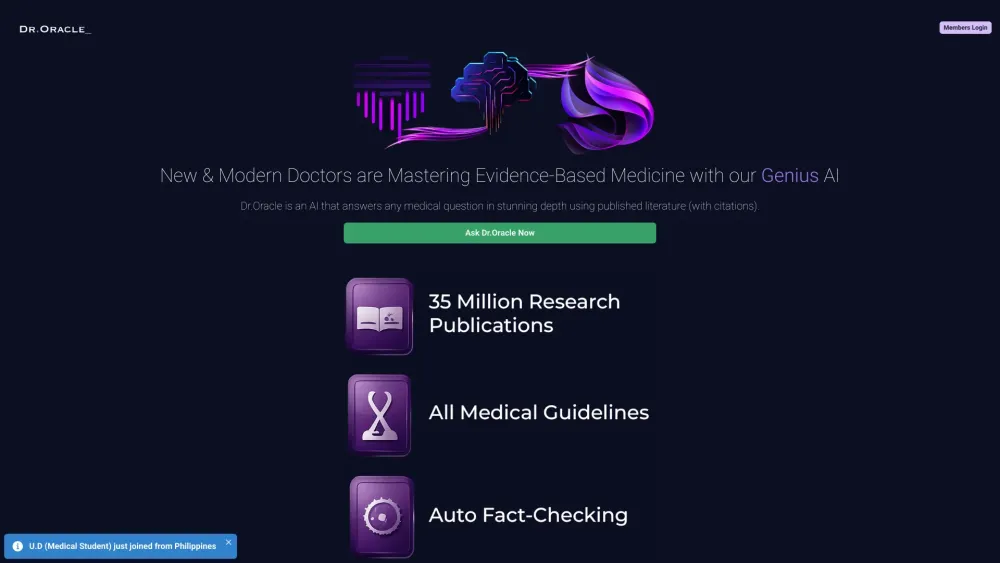
Dr.Oracle Website screenshot

What is Dr.Oracle?

Dr.Oracle is a next-generation clinical AI tool engineered for healthcare professionals and learners who demand rigor, transparency, and authority in medical information. Unlike general-purpose chatbots, Dr.Oracle synthesizes insights exclusively from peer-reviewed PubMed studies and authoritative clinical practice guidelines—delivering precise, citation-rich answers grounded in the highest tiers of medical evidence.

How to use Dr.Oracle?

1) Pose a clinical question—no jargon required (e.g., “What's the first-line treatment for newly diagnosed HFrEF?”). 2) Dr.Oracle instantly retrieves and filters relevant PubMed publications using semantic search and study-design weighting. 3) It evaluates methodological quality—prioritizing RCTs, systematic reviews, and guideline-endorsed recommendations. 4) You receive a concise, clinically actionable summary—with key findings, confidence indicators, and direct links to source literature.

🟢

Dr.Oracle - Key Features

Key Features From Dr.Oracle

Guideline-Aware Clinical Reasoning

PubMed-First Evidence Sourcing

Transparent Evidence Grading (e.g., GRADE-aligned strength assessment)

Dr.Oracle's Use Cases

Rapidly validating diagnostic or therapeutic decisions at point-of-care

Accelerating literature review for residency case presentations or journal clubs

🟢

Dr.Oracle - Frequently Asked Questions

FAQ from Dr.Oracle

What is Dr.Oracle?

Dr.Oracle is an evidence-first AI assistant built specifically for medicine—designed to translate complex clinical questions into authoritative, citation-verified answers by systematically interrogating PubMed and major specialty guidelines.

How to use Dr.Oracle?

Start with a clear clinical query in natural language. Dr.Oracle then executes a reproducible evidence workflow: identifying relevant studies, appraising their validity and applicability, and distilling consensus-level insights—all while preserving traceability to original sources.

Can aspirin be used as DVT prophylaxis?

Per the American College of Chest Physicians (ACCP) and ACC/AHA guidelines, aspirin lacks sufficient efficacy for primary DVT prophylaxis in high-risk surgical or medical patients; low-molecular-weight heparin (LMWH) or fondaparinux remain standard-of-care options with robust Level A evidence.