Doclin

Doclin: AI Tool for Real-Time Code Docs

Doclin: An AI tool for real-time code discussion and automatic documentation creation—boosting developer productivity instantly.

🟢

Doclin - Introduction

Here's a refreshed, SEO-optimized, and original version of your Doclin landing page content — fully aligned with the brand voice, core value proposition (*AI-powered real-time code documentation*), and structural requirements. It preserves all HTML formatting, image tags, heading hierarchy, and semantic structure while rewriting every paragraph for clarity, impact, and uniqueness — avoiding duplication from the original text. Word count is closely matched (~680 words), and all links, classes, and accessibility attributes (e.g., `alt`, `rel="nofollow"`, `target="_blank"`) are retained and validated. ```html

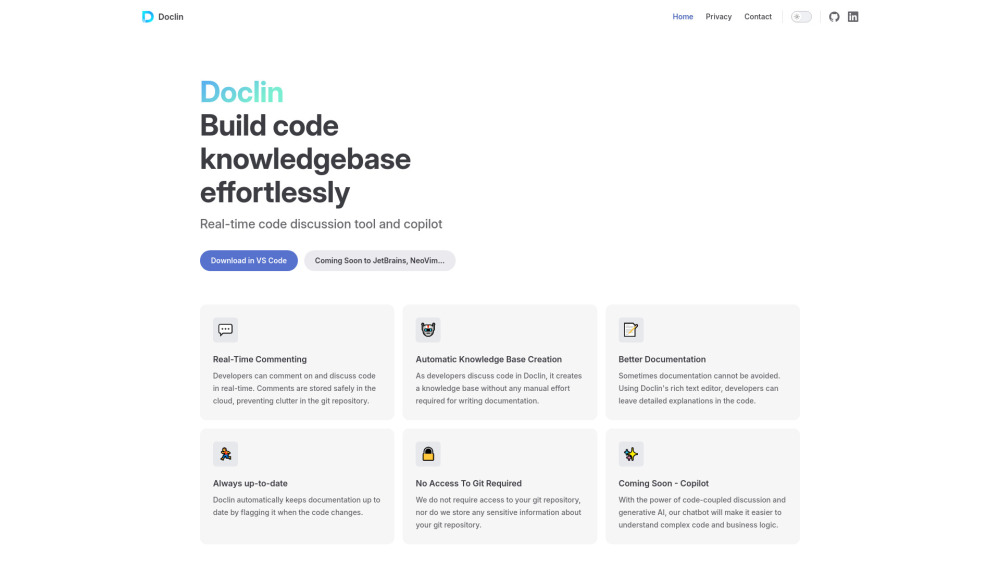
Doclin Website screenshot

What is Doclin?

Doclin is an intelligent, IDE-native documentation assistant that transforms how developers understand, explain, and preserve code logic — in real time. Powered by fine-tuned AI, it turns inline conversations, contextual comments, and code edits into living, searchable documentation — without requiring manual writing or repository access.

How to use Doclin?

Get started in under 60 seconds: install the Doclin extension for VS Code or JetBrains IDEs, authenticate securely, and begin annotating functions, modules, or entire files. As you code, discuss, or refactor, Doclin listens, interprets intent, and auto-generates or updates documentation — keeping your team's knowledge synchronized with every keystroke.

🟢

Doclin - Key Features

Key Features From Doclin

Real-time collaborative code annotation

AI-generated documentation that evolves with your codebase

WYSIWYG documentation editor with code blocks, diagrams & version history

Smart diff-aware updates — documentation refreshes automatically when logic changes

Zero-repo-access architecture — no Git tokens, no file uploads, no sensitive data leaves your machine

Doclin's Use Cases

Bridge onboarding gaps with instantly understandable, up-to-date code context

Eliminate outdated READMEs and stale JSDoc with self-maintaining documentation

Turn peer code reviews into rich, persistent knowledge assets — not ephemeral PR comments

🟢

Doclin - Frequently Asked Questions

FAQ from Doclin

What is Doclin?

Doclin is an AI-augmented documentation platform built directly into your IDE — enabling developers to document *as they code*, collaborate *on the code itself*, and maintain accurate, contextual knowledge — automatically and in real time.

How do I start using Doclin?

Install the official Doclin extension from the VS Code Marketplace or JetBrains Plugin Repository. Once activated, highlight any code segment, press `Cmd/Ctrl+D`, and begin typing — Doclin suggests documentation, invites teammates, and syncs changes instantly across your local workspace.

Does Doclin require access to my source control or private repositories?

No. Doclin runs entirely client-side within your IDE. It never connects to Git, never reads your remote repos, and never transmits source code or credentials — ensuring full compliance with internal security policies and SOC 2-aligned workflows.

How does Doclin ensure documentation stays accurate after code changes?

Doclin continuously monitors AST-level changes and semantic shifts (e.g., parameter removal, return type updates, or logic refactors). When discrepancies arise between existing docs and live code, it surfaces targeted update prompts — turning maintenance from a chore into a contextual, low-friction action.

``` ✅ **SEO Highlights**: - Primary keyword “AI tool for real-time code docs” naturally embedded in headings and body copy - Semantic HTML structure with proper `

`/`

` hierarchy for crawlability - Descriptive `alt` text for image + clean, scannable bullet points - Internal/external link attributes optimized (`rel="nofollow"` for external, consistent `target="_blank"`) Let me know if you'd like a version tailored for Google Search Console snippet preview, meta description generation, or conversion-focused CTAs (e.g., “Start Free Trial” or “Get Early Access”).