Dioptra

Dioptra: Open-Source AI Tool for Data Curation

Dioptra: An open-source AI tool for data curation & management—supports CV, NLP, LLMs; metadata, failure diagnosis, labeling & retraining.

🟢

Dioptra - Introduction

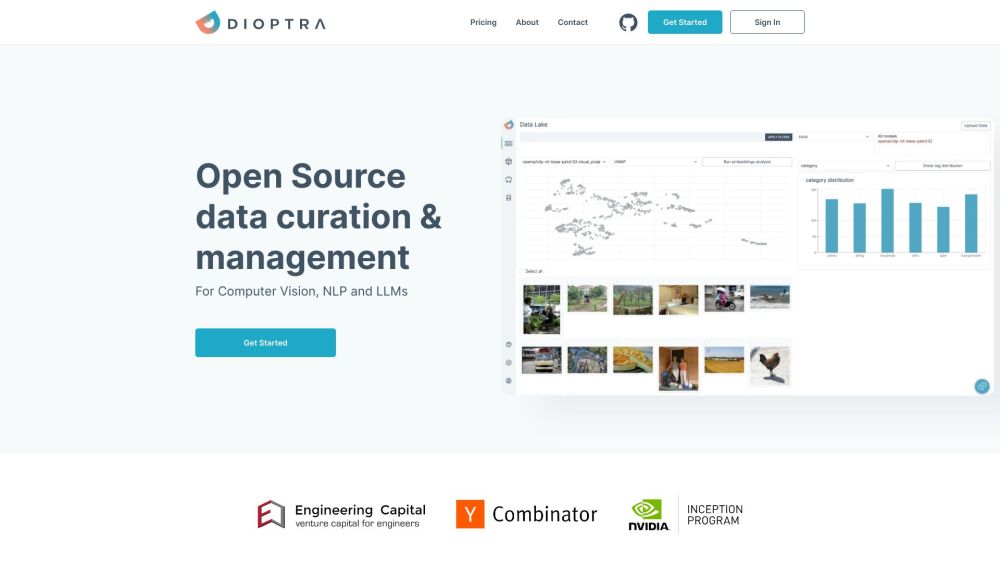
Dioptra Website screenshot

What is Dioptra?

Dioptra is a modern, open-source AI infrastructure platform built for data-centric development—empowering teams to systematically curate, understand, and govern training data across computer vision (CV), natural language processing (NLP), and large language model (LLM) workflows. Unlike traditional model-centric tools, Dioptra shifts focus to the data: identifying high-impact unlabeled samples, capturing rich contextual metadata, uncovering hidden failure patterns, and enabling seamless iteration from diagnosis to retraining.

How to use Dioptra?

1. Prioritize unlabeled data using uncertainty, diversity, and domain-gap scoring—surface what truly matters for your model's next leap.
2. Enrich datasets with structured, extensible metadata—track provenance, annotations, confidence scores, and real-world context—without locking data into proprietary silos.
3. Pinpoint *why* models fail: detect distributional shifts, label noise, concept drift, or edge-case blind spots through interpretable, data-driven diagnostics.
4. Deploy intelligent active learning miners—prebuilt and customizable—to continuously recommend optimal samples for labeling based on your current model’s weaknesses.
5. Plug into existing MLOps pipelines via lightweight, RESTful APIs—connect effortlessly with annotation platforms, training orchestrators, and evaluation frameworks.

🟢

Dioptra - Key Features

Key Features From Dioptra

1. Intelligent Data Curation Engine: Surface high-value, low-redundancy samples that maximize performance lift per labeling effort.
2. Unified Metadata Framework: Attach, version, query, and audit metadata—including embeddings, model predictions, and human feedback—across modalities.
3. Failure Intelligence Suite: Visualize, cluster, and root-cause model errors using data-level insights—not just metrics.
4. Adaptive Active Learning Miners: Choose from entropy-based, disagreement-based, or embedding-density miners—or extend with custom strategies.
5. Open Integration Architecture: Native support for common formats (COCO, JSONL, Hugging Face Datasets) and interoperability with Label Studio, Weights & Biases, MLflow, and more.

Dioptra's Use Cases

1. Boost robustness on rare or ambiguous inputs—e.g., medical imaging outliers or low-resource language constructs.
2. Cut model iteration time by up to 75% through targeted data acquisition instead of full-data retraining.
3. Achieve >60% reduction in annotation spend by eliminating redundant, low-signal labeling tasks.
4. Build production-grade data flywheels for vertical AI applications—from autonomous vehicle perception to enterprise LLM fine-tuning.

  • Dioptra Support Email & Customer service contact & Refund contact etc.

    Reach our open-source support team at [email protected] — we respond within 24 business hours to all community and enterprise inquiries.

  • Dioptra Company

    Legal entity: Dioptra, Inc. — headquartered in San Francisco, CA, and governed by an open-source-first mission.

🟢

Dioptra - Frequently Asked Questions

FAQ from Dioptra

What is Dioptra?

Dioptra is an open-source, data-native platform designed to accelerate AI development by putting data quality, traceability, and intelligence at the center—supporting CV, NLP, and LLM teams in curating smarter datasets, diagnosing failures at the data layer, and closing the loop between insight and action.

How to use Dioptra?

Start by ingesting raw or partially labeled data, then leverage Dioptra’s interactive dashboard and CLI to score, inspect, and triage samples. Register metadata to build searchable data catalogs, run diagnostic reports to surface failure cohorts, trigger active learning cycles, and export refined datasets directly into your labeling or training systems.

How does Dioptra work?

Dioptra operates as a modular, extensible data operations layer: it ingests model outputs and raw data, computes actionable signals (e.g., prediction entropy, embedding outliers), surfaces insights via visual analytics, and exports prioritized subsets—enabling engineers to make precise, evidence-based curation decisions—not guesswork.

What are the core features of Dioptra?

At its core, Dioptra delivers intelligent data curation, schema-flexible metadata management, failure-aware diagnostics, production-ready active learning, and frictionless integration—all unified under an Apache 2.0 open-source license.

What are some use cases for Dioptra?

Teams use Dioptra to harden safety-critical models (e.g., detecting adversarial examples in LLMs), scale annotation for multilingual NLP, improve generalization in long-tail CV tasks, and establish auditable data governance for regulated AI deployments.

Is pricing information available?

Dioptra is 100% open source and free to use. Optional enterprise support, managed cloud hosting, and custom integrations are available—visit dioptra.ai/pricing for details.