ChatTTS

ChatTTS: AI Tool for Natural Multilingual Conversational Speech

ChatTTS: A cutting-edge AI tool for natural, multilingual (CN/EN) conversational speech synthesis—ideal for LLM assistants and audio/video intros.

🟢

ChatTTS - Introduction

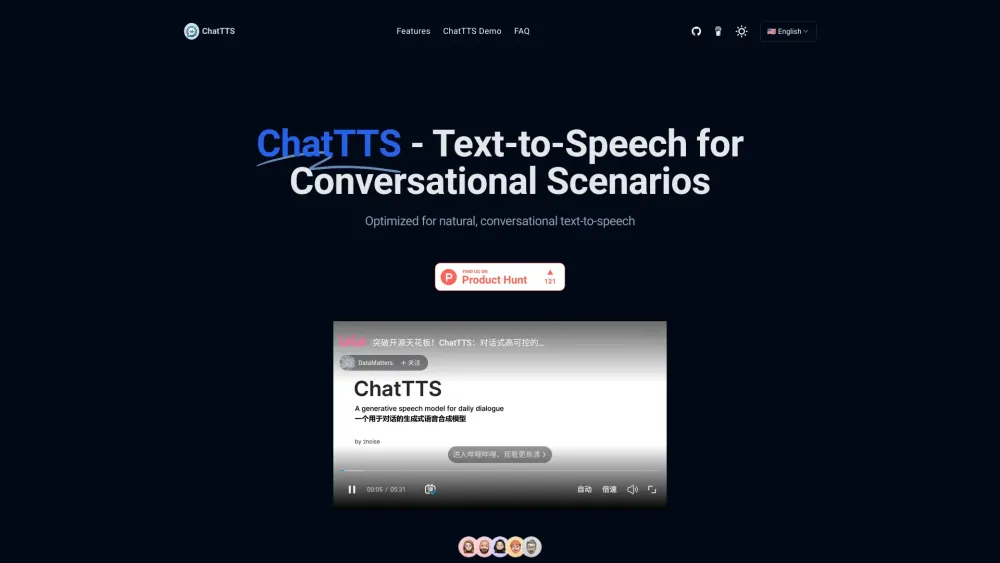
ChatTTS Website screenshot

What is ChatTTS?

ChatTTS is a next-generation conversational speech synthesis engine built for realism, rhythm, and contextual fluency—designed from the ground up to power human-like dialogue. Hosted openly on GitHub (2noise/chattts), it bridges the gap between traditional TTS and dynamic, context-aware voice generation. Unlike static voice models, ChatTTS excels in turn-taking intonation, pause-aware prosody, and expressive delivery—making it uniquely suited for LLM-powered chatbots, interactive tutorials, multilingual podcast intros, and AI-driven video narration. With native support for both Mandarin Chinese and English—and trained on over 100,000 hours of high-fidelity, conversationally annotated speech—it delivers nuanced vocal performances that reflect natural speaker variability, emotion, and linguistic cadence.

How to use ChatTTS?

Getting started with ChatTTS is streamlined for developers and creators alike: clone the official repository, set up the lightweight Python environment, load the pre-trained model, and pass in your script—whether a single line or multi-turn dialogue. The toolkit includes intuitive inference APIs for fine-grained control over speaking rate, pitch, emphasis, and language switching. You can generate WAV or MP3 output instantly, embed audio directly into web apps via Web Audio API, or pipeline speech into real-time LLM agents. Comprehensive Jupyter notebooks, CLI utilities, and RESTful wrapper examples are included to accelerate prototyping and production deployment.

🟢

ChatTTS - Key Features

Key Features From ChatTTS

Conversational-first architecture—designed for dialogue, not monologue

Seamless bilingual synthesis: fluent switching and co-articulation between CN & EN

Massively scaled training: 100K+ hours of diverse, spoken-language data

Built-in prosodic intelligence: breath, pause, stress, and intonation modeling

ChatTTS's Use Cases

Powering responsive, voice-native LLM assistants (e.g., voice chatbots, AI tutors)

Creating engaging, personality-infused intros/outros for YouTube, TikTok, and podcasts

Enabling real-time multilingual narration for e-learning, accessibility tools, and digital avatars

🟢

ChatTTS - Frequently Asked Questions

FAQ from ChatTTS

What is ChatTTS?

ChatTTS is an open, research-backed conversational TTS framework engineered to replicate the spontaneity and expressiveness of human speech—not just read text aloud. It's purpose-built for interactive AI systems, supporting rich vocal behaviors like laughter cues, trailing-off, and emphatic repetition—all while maintaining native-level fluency in both Chinese and English.

How to use ChatTTS?

Use ChatTTS by installing its PyPI package or cloning the GitHub repo, then calling chat.infer() with your input text and optional voice parameters. No GPU required for inference—optimized for CPU and consumer-grade hardware. Prebuilt Docker images and Hugging Face Spaces demos are also available for zero-config testing.

What can ChatTTS be used for?

Beyond standard TTS applications, ChatTTS shines in scenarios demanding vocal authenticity: empathetic customer service bots, adaptive language-learning companions, AI co-hosts for live streams, and dynamic voice branding for SaaS products—all with consistent, recognizable voice identity across languages.

Does ChatTTS support multiple languages?

Yes—ChatTTS natively supports high-quality Chinese (Mandarin) and English, including cross-lingual code-switching within the same utterance. Its phoneme-aware tokenizer and bilingual acoustic modeling ensure accurate pronunciation, tone preservation (for Mandarin), and natural rhythm alignment—no fallback to generic “accented” speech.

How can developers integrate ChatTTS into their applications?

Developers can integrate ChatTTS via Python SDK, REST API (with FastAPI backend), or browser-based WebAssembly build. Full documentation covers WebSocket streaming for low-latency voice responses, batch processing for content farms, and fine-tuning pipelines for custom voice cloning—without retraining the full model.

What kind of data is used to train ChatTTS?

ChatTTS is trained on a meticulously curated corpus of ~100,000 hours of conversational speech—including spontaneous dialogues, call-center interactions, educational Q&A sessions, and scripted-but-naturalistic voiceovers—balanced across gender, age, regional accents (e.g., Beijing Mandarin, American Southern English), and speaking styles.

Is there an open-source version of ChatTTS available for developers and researchers?

Absolutely. The core ChatTTS model and training code are fully open-sourced under MIT License. A distilled, 40,000-hour variant is publicly released for reproducibility and academic use—complete with training logs, evaluation benchmarks (MOS, WER, Prosody Score), and community-contributed voice adapters.