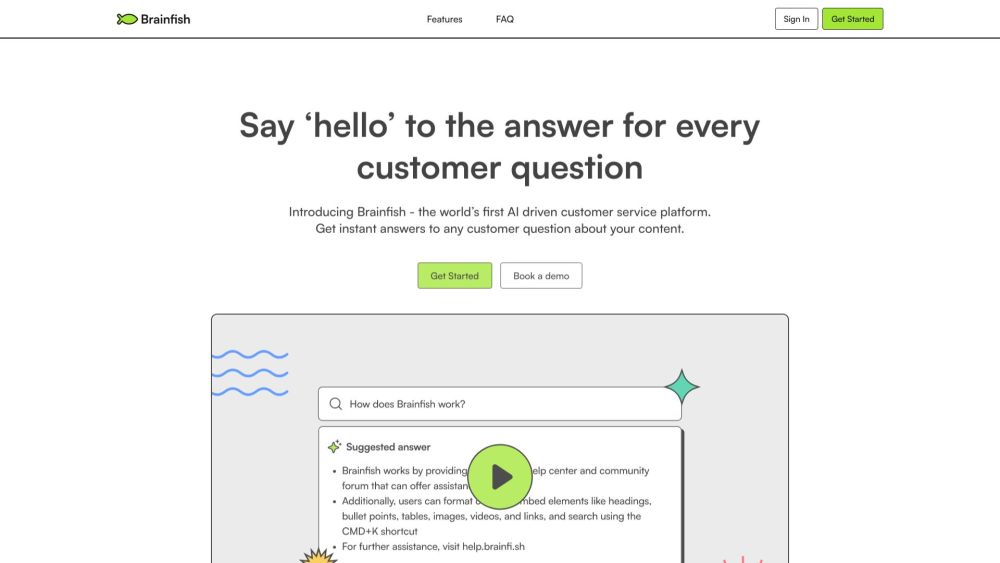
FAQ s, manuals, policies, or even video transcripts), let Brainfish ingest and semantically index your knowledge, then embed its smart answer widget on your website, app, or help portal. No coding required — just seamless, intelligent support, live from day one.
Key Features From Brainfish
Truly autonomous AI help center
Zero-latency, human-grade answers
Dramatically fewer escalations & wait times
Proactive CX uplift across touchpoints
Up to 60% reduction in support overhead
Brainfish's Use Cases
24/7 automated customer support
AI-augmented content intelligence
Knowledge gap detection & refinement
Dynamic, self-updating FAQ systems
Scalable deflection of Tier-1 tickets
FAQ from Brainfish
What is Brainfish?
Brainfish is the pioneering AI help center that transforms static documentation into a responsive, learning support layer — delivering instant, accurate, and brand-aligned answers without human intervention.
How to use Brainfish?
Upload your knowledge assets → activate AI indexing → deploy the embeddable answer engine. That’s it. Your customers get expert-level responses before they even hit “send.”
How does Brainfish work?
Using fine-tuned retrieval-augmented generation (RAG) and domain-specific grounding, Brainfish reads your content like a subject-matter expert — retrieving facts, inferring context, and generating natural-language answers that reflect your voice and policies.
What are the core features of Brainfish?
It combines an adaptive AI help center, sub-second answer delivery, near-elimination of first-response delays, measurable CX improvements (NPS + CSAT), and significant cost savings through automation efficiency.
Who can benefit from using Brainfish?
Growth teams, support leaders, product managers, and CX designers — anyone responsible for reducing friction, scaling trust, and turning knowledge into competitive advantage.
How can Brainfish help reduce support ticket volume?
By resolving ~75% of repetitive, information-based queries instantly and accurately, Brainfish prevents tickets from being created — freeing agents to focus on high-value, empathetic interactions instead.