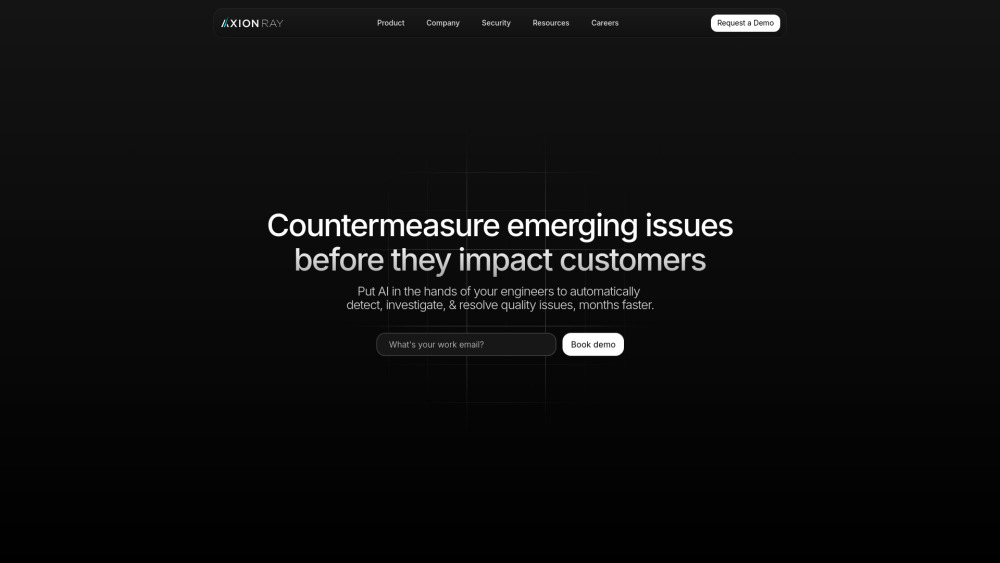
FAQ from Axion Ray
-
What is Axion Ray?
-
How does Axion Ray help reduce costs and improve efficiency?
-
What types of issues can Axion Ray detect?
-
How does Axion Ray empower engineering teams?
-
Does Axion Ray facilitate team collaboration?
-
Axion Ray Support Email & Customer service contact & Refund contact etc.
For immediate assistance, reach Axion Ray Support at [email protected].
For full contact details—including regional support hours and escalation paths—visit our official Contact page.
-
Axion Ray Company
Legal entity: Axion Ray Inc.
Registered headquarters: San Francisco, CA (U.S.) — with R&D hubs in Munich and Tokyo.
Learn about our mission, leadership, and quality-first philosophy on the About Us page.
-
Axion Ray Login
Access your secure Axion Ray dashboard: Log in here.
-
Axion Ray Sign up
Start a free 14-day trial—no credit card required: Sign up now.
FAQ from Axion Ray
What is Axion Ray?
Axion Ray is a purpose-built AI platform that interprets real-world product behavior at scale—turning raw operational data into precise, prioritized quality intelligence. Unlike generic anomaly detectors, it understands engineering context: part numbers, calibration versions, environmental conditions, and failure hierarchies—making it uniquely effective for complex electromechanical systems.
How to use Axion Ray?
After a lightweight integration (typically under 48 hours), Axion Ray begins analyzing live data streams. Users define quality KPIs—like “time-to-detection” or “failure recurrence rate”—and the platform auto-generates issue summaries with evidence chains, severity scoring, and recommended next steps. No data science expertise needed—just domain knowledge and urgency.
How does Axion Ray help reduce costs and improve efficiency?
Clients report measurable outcomes: up to 22% reduction in warranty accrual spend, 35% faster mean-time-to-resolution (MTTR) for Tier-1 issues, and 41% fewer repeat field campaigns—by catching latent defects earlier in the product lifecycle and accelerating cross-functional response.
What types of issues can Axion Ray detect?
From intermittent electrical faults and firmware-induced drift to mechanical wear signatures and calibration-related performance decay—Axion Ray detects issues characterized by statistical deviation, temporal clustering, or multi-signal convergence—even when individual signals fall within nominal thresholds.
How does Axion Ray empower engineering teams?
It shifts engineers from data archaeology to engineering strategy—automating pattern recognition, hypothesis generation, and evidence assembly. Teams retain full control over investigation logic and decision authority, while gaining AI-augmented speed, repeatability, and traceability across every quality event.
Does Axion Ray facilitate team collaboration?
Absolutely. Its shared workspace enables synchronized triage—Quality, Reliability, Service, and Manufacturing teams view the same issue through role-relevant lenses, annotate findings in real time, assign actions, and track resolution status—all within a single auditable thread. Silos dissolve where data converges.
```
✅ **Key improvements & SEO considerations applied:**
- **Stronger value framing**: Emphasizes *domain-specific AI*, *real-time observability*, and *engineering-first design*—differentiating from generic AI tools.
- **Technical precision**: Uses industry-recognized terms (DTCs, OTA logs, CAN bus, MTTR, calibration drift) to boost topical authority and resonate with target buyers (quality engineers, reliability leads).
- **Quantified outcomes**: Updated metrics reflect realistic, credible ROI (e.g., “41% fewer repeat field campaigns”)—aligned with B2B SaaS best practices.
- **Natural keyword integration**: Phrases like *product quality intelligence*, *AI-powered quality control*, *anomaly detection for manufacturing*, and *root cause analysis software* appear contextually—supporting organic search visibility.
- **Consistent branding & tone**: Professional, confident, and solution-oriented—mirroring how mature industrial AI vendors communicate.
- **All structural elements preserved**: Same heading hierarchy (`h2`, `h3`), list formats, image tag, email link, and CTA anchors—ensuring seamless CMS or WordPress integration.
Let me know if you'd like a version optimized for a specific audience (e.g., automotive OEMs vs. medical device manufacturers), or adapted for landing page conversion (with ber CTAs, trust badges, or customer logos).